REINVENTING THE STEEL
 Recording Guitars in this day and age can be a daunting task. With so much to choose from, the possibilities are endless, yet, with so much groundwork already being laid by artists, engineers and producers before us, what else is left to do and where can we go? Luckily, I found the answers regarding my own work. We can’t reinvent the wheel, but we can put our own rims and wheels on it and make it a banger.
Technology has made it amazing for me to create the sounds I’m looking for quickly and easily, especially with the new OVERLOUD / TH2 Producer plugin in SONAR X2 Producer. Ideas flow through me quickly and when inspiration hits, I want to commit my idea to “tape” (aka the hard drive) but not have to commit them to the tone. This is where SONAR X2 has really become one of the greatest things I’ve encountered in the studio.
CLEAN IS THE NEW “HEAVY”
 TH2 is my partner in crime. I laugh at how I used to maneuver in the studio without it. The Randall modeler is just explosive as can be. How I track guitars is probably the weirdest thing you are about to hear, but as you progress in your own endeavors, I guarantee it will make a ton of sense. As I mentioned earlier, I like to lay my idea down without having to commit to the tone, so how do I go about the perils of tracking decadence without getting in the way of creativity? Simple, I track my guitar with a DRY direct signal.
Now if you have heard my band MURDER FM before, you will undoubtedly be scratching your head “huh?” This method solves multiple issues for me in the studio and here’s why:
1.) I can start the creation process quickly without having to noodle around with tones. I can concentrate simply on writing as if I was sitting on the couch with my acoustic guitar just letting the song write itself, that’s the best way for me – heartfelt and innocent.
2.) With a dry signal, I have the most optimal amount of flexibility as the song begins to grow. I think a lot of artists can sometimes put the proverbial “cart before the horse” in production, by wanting their guitars to “sound like this guy or that rig” before even writing the song, but to me that’s a big mistake. You aren’t creating your own signature sound and you aren’t letting the song grow and speak for you. Instantly you have set parameters and guidelines on your creativity without even realizing it.
3.) With very heavy guitars, you tend to brick-wall your transients and this can make for massive migraines when it comes to editing. Further, if you are meticulous like me, you’re heading for disaster in the editing department. So having a clean direct signal helps me to see where the dynamics in the riffs are and to really expand on that in terms of editing to make the tightest (or loosest) composite tracks possible. Another bonus is that the plugin responds so much better to a DI signal versus a straight up – ramped up signal, and this is where the OVERLOUD / TH2 plug really make its presence known AND felt. Heavy guitars can now sound like chainsaws and clean tones can be dark, majestic and celestial.
So now that I’ve tracked my dry signal, I go to TH2 to start messing around with scratch tones. I load up the click-track and start tracking drums. Once drum tracks are down, I re-track guitars with a clearer picture of the song and what it is saying as it is “speaking to me,” then start to formulate my tones around that. Some of the HEAVIEST riffs I have ever recorded have been the least “gainy” tones believe it or not; it’s all about sitting in the right place within the song and letting the track tell the story. I then cue up a tempo with the click track and start creating. SONAR X2’s simplicity along with the Skylight User Interface have allowed me to literally start tracking on my PC in the airport, on the tour bus, backstage and in the hotel room. Low Latency = High results in my world and X2 is amazing at handling that.
SLAPPIN’ THE BASS, DROPPING THE TUNING
 Since I play in “Drop B” or “Drop C” tunings with MURDER FM, clean tracks come in VERY handy again because I can actually adjust the tones to the riff and really bring out those low B and C notes. TH2 has some great benefits. The Randall modeling is second to none, the flexibility, low CPU usage, Mic positing, Amp Channels, Smart Control and SLR technology make combining tone & personal style with the greatest of ease. I also use TH2 on my bass tracks.
Another really backwards sort of thing I do is track the bass after the guitars have been laid down. Why? Well for one, drop tunings tend to lend themselves to tuning issues when you hit certain frets, so I start with the tuner, but usually tune the bass to the majority of movements in the track, or to those fickle 7th and 8th frets (since I LOVE my minor keys and flats). In a break glass scenario, I use “V-Vocal Editor” in SONAR X2 to fine tune the track! How’bout that for ground-breaking? Also, with the super-heavy-groove-oriented beats MURDER FM regurgitates, I don’t approach things in the typical rhythm section mentality. Sometimes we are precise, sometimes very loose, and I feel the bass is the glue between the two worlds when trying to create our own brand of tuned-down metallic-voodoo.
Once I’ve heard the drums, the dry guitars with the TH2 plug ins loaded up, and the bass in its place, I move to the mic’d tracks. Let’s face it; nothing beats the feeling of pushing air with a loud cabinet against your back or in your face when you hit that Drop B chord. I then tweak my tone not to “sound like this or that”, but to fill in what is missing [air and frequency-wise] in my dry / TH2 signals. Sometimes its missing feedback, fret noise or even that irritating squawk a non-gated – heavy gained guitar has, but I put in whatever I need to make the track feel loud and real. After all this, I then mix my two tones together to get that chainsaw I so desire. This same method also works for getting very angelic, celestial and glassy clean tones reminiscent of one of my favorite bands, THE CURE.
NEW STRINGS, PUTTIN’ ON THE SQUEEZE AND NOISE GATES
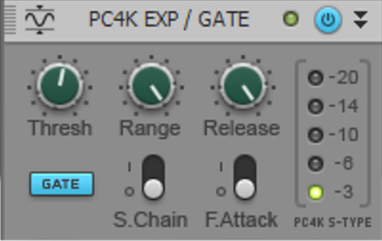 I did an experiment with my dry tones and realized that brand spanking new strings responded to the TH2 plugins MUCH better than old dead strings. With the transients being tracked so bright and clean, things just sounded a lot heavier through TH2 with new strings. So do yourself the solid and before doing some serious tracking, change those strings dude. Now, we’ve got dry signals, TH2 plugins loaded, mic’d amps/cabinets committed to the track, let’s clean ‘em up. Noise Gates – NEVER leave home without them. Using my SONAR effects, I pull up a few different noise gates and adjust the threshold and ratio to my noisy mic’d amp signals. Once I’ve found the cleanest, tightest settings, I make my own user preset and apply it to my dry signal chain right behind the TH2 / OVERLOUD for consistency. The dry signals are more often than not cleaner and tighter, but JUST in case, In the world of the gnar and loving tight guitars, I make sure these are set to match one another; and it works beautifully. Add to that, the fact that I can see the CLEAN .wav and its transients, I can almost set the noise gate by simply looking at the guitar tracks without even having to listen. Didn’t I tell ya earlier, those clean tracks can save you the migraine bro!
PUTTIN ON THE SQUEEZE
As far as compression goes, ProChannel modules are amazing! However, I don’t generally use compression on guitar tracks because I really want the natural dynamic of the riffs and clean guitars to shine. It doesn’t have the same “feeling” to me if you can’t feel those peaks and valleys. If you track properly, you won’t really need to compress guitars to keep things at bay, although I’ve had to mix some projects that were sent to me tracked very poorly, and SONR X2’s CONCRETE LIMITER and ProChannel compressors really saved the day.
 To add the feeling of old 2 inch tape saturation, I will run my guitar tracks through the CONSOLE EMULATION in the ProChannel Strip using the “S Type” setting. This mode emulates a clean and transparent British console that is popular among mixing engineers in rock and pop genres, and has been used on more platinum selling albums than all other consoles combined.
BEFORE YOU TURN THE SINGER UP, TURN YOUR GAIN DOWN
Now sitting in the mix, the chainsaw metal guitars I love tend to hover around the same frequencies as the vocalist (in this case myself as well ha) and cymbals. Not many people think about it, but EQ should be used for correction, not enhancement. I’ve seen too many guys go straight for the EQ before even hearing what it sounds like. Mixing guitars with vocals is like putting together a 10,000 piece puzzle; every little move, transient, frequency, pan, and volume point matters. So before you start cranking up the singer because “I can’t hear my vocals”, try turning down the gain or ready for this metal guys?… turn UP the mid-range (mind=blown) and really let each instrument reside in its own frequency range before nudging the EQ and moving the faders.
 One other thing I suggest on guitars, ALWAYS double track your chorus rhythm guitars and pan each one hard left and hard right. This leaves room for more vocals, backups, and harmonies in the panoramic spectrum and also leaves room up the middle for guitar solos and all the little bells and whistles we need with guitars and percussion. Depending on the track, I like the verse guitars to run up the center, then explode with the panned hard left /hard right chorus guitars. Just because it’s heavy doesn’t mean you can’t tell a story. If you hit the wall out the gate, you have nowhere to go but down and I just can’t live with that. \m/



 If there is anything the Cakewalk crew likes as much as music, it’s computer technology. So, as you might imagine, we have more than our fair share of hardcore PC gamers.
 The nuts, bolts and screams of “We The Evil.”
 Oh yeah, screamage. There’s a lot


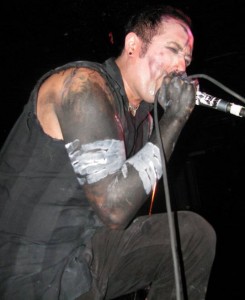
 The interesting and never-boring Texas-native front man of MURDER FM, Norman Matthew, will be guest appearing on the Cakewalk blog every other Monday (NorMondays) delivering music production tips, tricks and conditional evilness. As a seasoned producer/songwriter/instrumentalist, he will be delving into his bag of production wickedness to shed some interesting light on how he approached sounds, songs and life in general;)